
Security flaws and lean AI developer tooling #6

Today's Letter
- xAI, Grok 4.3 docs page now listed
- cPanel & WHM auth bypass hits supported versions
- Semgrep reports Shai-Hulud malware in PyTorch Lightning
- DuckDB, Full-Text Search extension walkthrough published
- Pu.sh, 400-line shell coding-agent harness posted
xAI, Grok 4.3 docs page now listed
- xAI has published a developer docs page titled Grok 4.3.
- The primary source is a docs shell page and exposes no model specs, benchmarks, or pricing.
- The page sits inside xAI's API docs alongside models, rate limits, and cost tracking sections.
- Nearby tool docs list web search, X search, code execution, RAG, and remote MCP tools.
- xAI also surfaces text, image, video, voice, and files capability sections in the same docs tree.
- Based on the primary page alone, performance claims, launch dates, and access terms remain unconfirmed.
- The update mainly confirms Grok 4.3 branding in xAI's developer documentation surface.
Source: docs.x.ai
More: news.google.com
cPanel & WHM auth bypass hits supported versions
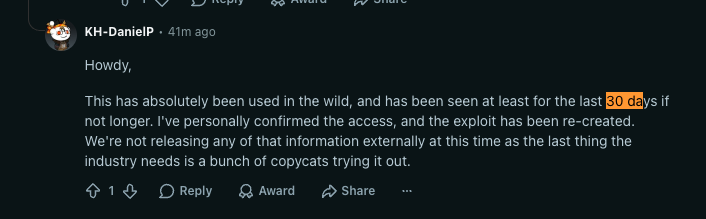
- watchTowr disclosed CVE-2026-41940 on April 29, 2026 as an authentication bypass in cPanel & WHM.
- The issue affects all currently supported release tiers, according to cPanel's advisory.
- KnownHost said the flaw had already been exploited in the wild as a zero-day.
- Patched builds include 11.110.0.97, 11.118.0.63, 11.126.0.54, 11.132.0.29, 11.134.0.20, and 11.136.0.5.
- watchTowr's diff review points to session loading and saving logic as the attack surface.
- A new filter_sessiondata call strips characters such as CR, LF, =, and \\ from session fields.
- The patch also changes pass handling when no obfuscation secret is present, using a no-ob hex encoding path.
- Because WHM controls root-level hosting administration, exposure can affect a large internet-facing management plane.
Source: labs.watchtowr.com
More: news.google.com
Semgrep reports Shai-Hulud malware in PyTorch Lightning
- Semgrep reported on 2026-04-30 that a Shai-Hulud-themed malicious dependency was found in the PyTorch Lightning AI training library, still at single-source level.
- The report ties the case to PyTorch Lightning versions 2.6.2 and 2.6.3, with PyPI, npm, GitHub, and Octokit named in the incident context.
- The malware is described as using four parallel channels for execution and outbound communication, with traffic reaching port 443 according to the report.
- It also tries to spread by abusing npm publish credentials and republishing modified packages, the report says, rather than only affecting one local install.
- The write-up frames the issue as a software supply-chain risk for AI training stacks that depend on widely used Python packages.
- Independent confirmation was not provided in the supplied secondary material, so the incident remains in leak-stage reporting rather than an officially corroborated security advisory.
Source: semgrep.dev
More: news.google.com · github.com
DuckDB, Full-Text Search extension walkthrough published
- A new walkthrough outlined how DuckDB full-text search works through the `fts` extension, according to the report.
- The post says DuckDB uses Okapi BM25 scoring and supports stemming, stop-word removal, and accent stripping for indexed text.
- Setup is described as `INSTALL fts;` and `LOAD fts;`, then `PRAGMA create_fts_index('emails', 'id', 'subject', 'body');` on selected columns.
- The example dataset covers 13,010 `.eml` files in a multi-GB email corpus, with preprocessing done in Python 3.13 before JSON import.
- The preprocessing script extracts message bodies plus headers such as `from`, `to`, `subject`, `List-Id`, and `X-Mailer` to help filter mailing-list or transactional mail.
- The write-up compares DuckDB's current feature set with Elasticsearch and Postgres extensions such as `pgvector` and `pg_search`.
- A reported gap is result highlighting: the author notes there is no built-in equivalent to Postgres `ts_headline` yet.
- The post also points to the Snowball stemmer stack and `snowballstemmer` 3.0.1 as a way to inspect unexpected stemming behavior.
Source: peterdohertys.website
Pu.sh, 400-line shell coding-agent harness posted
- Pu.sh was posted as a coding-agent harness implemented in roughly 400 lines of shell, according to the project page.
- The install path shown is a single curl download followed by chmod and direct execution as a local script.
- The page positions the tool as a minimal stack with no npm, no pip, and no Docker, relying instead on curl, awk, and an API key.
- Available links on the page point to GitHub, documentation, and an MIT license, suggesting the project is intended for public inspection and reuse.
- Technical details beyond the landing page remain limited at this stage, and the exact agent workflow is not yet officially confirmed.
- The pitch targets developers who want a small, inspectable harness rather than a larger dependency-heavy coding-agent setup.
Source: pu.dev
Jocoletter curates AI, software, and product trends for developers and builders.
#DuckDB #Pu.sh #Semgrep #cPanel #xAI