
Copilot, Vercel, and model eval updates #64

Today's Letter
- GitHub Copilot adds Claude Opus 4.8 fast mode preview
- Vercel adds Dockerfile deployment on Fluid Compute
- Hugging Face adds EEE eval results to model pages
GitHub Copilot adds Claude Opus 4.8 fast mode preview
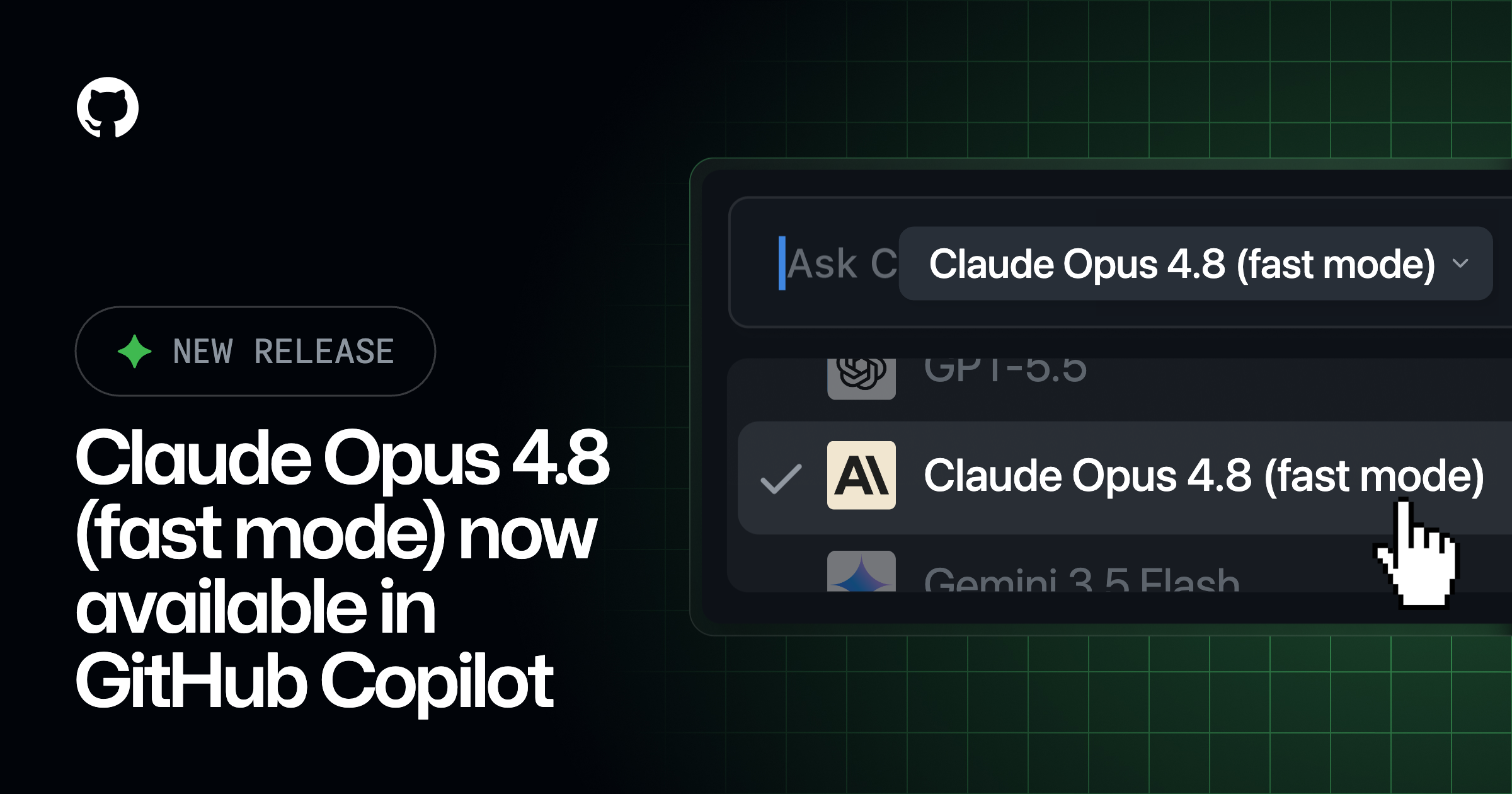
- GitHub started rolling out Claude Opus 4.8 (fast mode) in preview for GitHub Copilot on June 29, 2026
- The company says the mode keeps the same intelligence as standard Claude Opus 4.8 while delivering faster output token speeds
- GitHub positions it for interactive coding and agentic workflows where lower response latency matters
- The model will be selectable in VS Code, Visual Studio, Copilot CLI, GitHub Copilot cloud agent, the Copilot app, github.com, GitHub Mobile, JetBrains, Xcode, and Eclipse
- Access is planned for Copilot Pro+, Max, Business, and Enterprise users
- Enterprise and Business administrators must enable the Claude Opus 4.8 fast mode policy in Copilot settings, and the policy is off by default
- GitHub says billing follows provider list pricing under Usage Based Billing
- Fast mode is priced below previous fast modes, but still above standard Claude Opus 4.8, according to GitHub's pricing note
- Availability is gradual, so the model may not appear immediately for all eligible users
Source: github.blog
More: tech-insider.org
Vercel adds Dockerfile deployment on Fluid Compute
- Vercel introduced support for deploying any HTTP server defined by a `Dockerfile.vercel` file on its platform.
- The flow builds the image, stores it in the project registry, and deploys it to Fluid Compute through `vercel deploy`.
- The company said the same path works for Go, Rails, Spring Boot, Express, Laravel, ASP.NET, FastAPI, and nginx-backed services.
- Containers must listen on `$PORT`, which defaults to `80`, with the sample using `golang:1.24-alpine` and `alpine:3.20` in a two-stage build.
- Vercel positions containers as first-class workloads on the same platform as frontend apps and other services, with per-push preview URLs and shared observability.
- Billing is tied to active CPU time on Fluid Compute rather than wall time, according to the announcement.
- Vercel said startup is optimized through an internal boot-image format that streams and decompresses container snapshots on demand.
- Containers are stateless in the current model, with persistent data expected to live in external databases or caches; attached durable storage is described as in progress.
Source: vercel.com
Hugging Face adds EEE eval results to model pages

- Hugging Face made Community Evals interoperable with Every Eval Ever, adding cross-posted evaluation results to Hub model pages.
- The update also feeds those results into benchmark leaderboards registered through dataset repos with eval.yaml.
- Model-side scores live in .eval_results/*.yaml, and submissions can come from model authors or third parties through pull requests.
- Each linked result points back to the full EEE record, including generation settings, harness version, reproducibility notes, and optional per-sample JSONL data.
- Hugging Face said the EEE datastore has about 229,000 evaluation results covering more than 22,000 models and 2,200 benchmarks.
- The records were normalized from 31 reporting formats into one JSON schema for evaluator identity, model access path, settings, and metric meaning.
- Hugging Face published the post on June 30, 2026, and said official organization submissions receive a verified checkmark on EvalEval.
Source: huggingface.co
Jocoletter curates AI, software, and product trends for developers and builders.
#GitHub #HuggingFace #Vercel