
AI agents, Copilot metrics, and 4-bit diffusion #87

Today's Letter
- GitHub, Copilot impact metrics dashboard launched
- Hugging Face adds Nunchaku Lite 4-bit diffusion to Diffusers
- monday.com details AI agents on Amazon Bedrock
GitHub, Copilot impact metrics dashboard launched
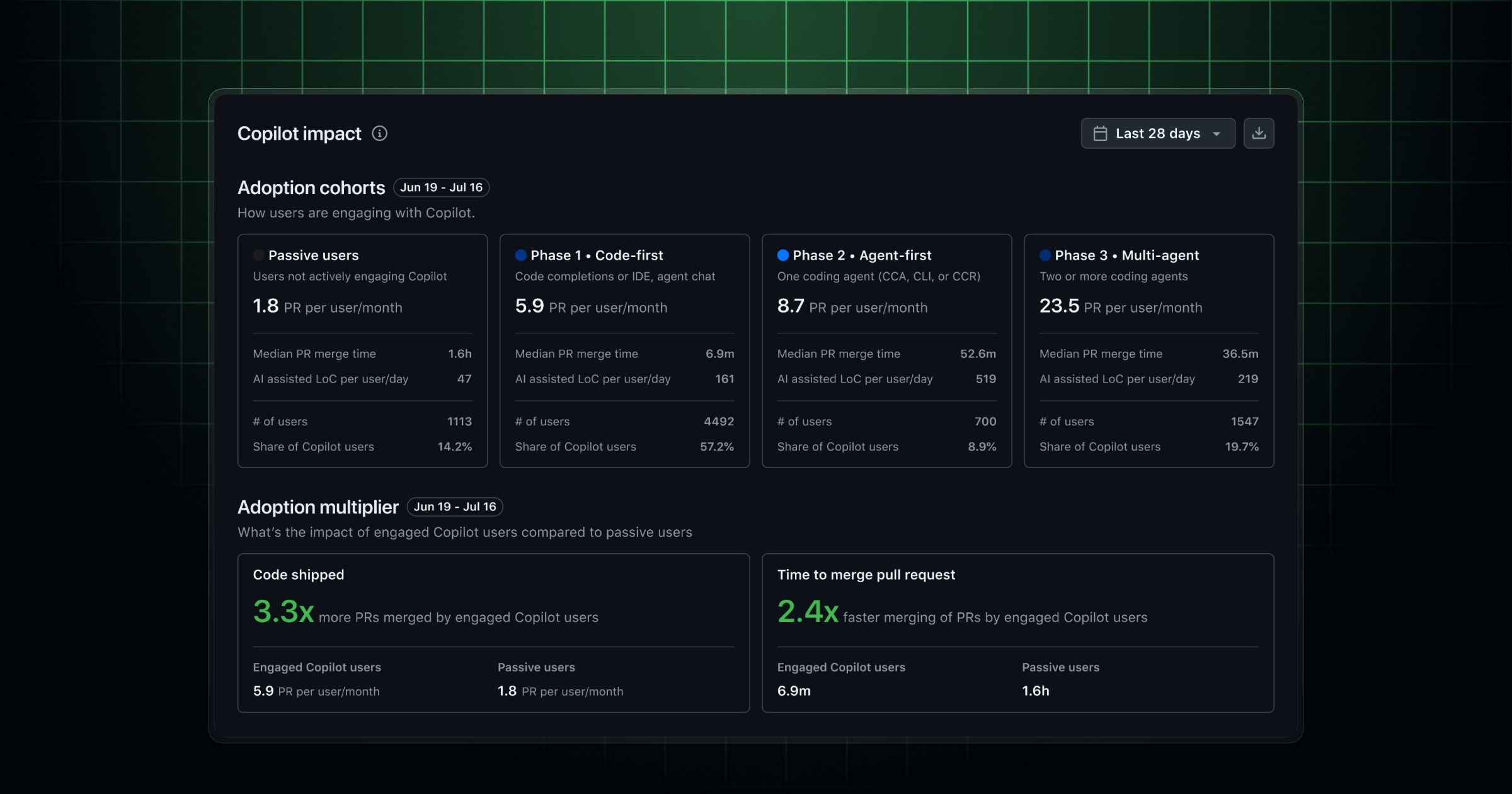
- GitHub launched a Copilot metrics impact dashboard on July 22, 2026 for enterprise administrators and organization owners.
- The dashboard groups licensed users into Passive, Phase 1 Code-first, Phase 2 Agent-first, and Phase 3 Multi-agent or Copilot app cohorts.
- Each cohort card shows users in phase, share of overall users, average pull requests merged per user per month, median merge velocity, and average lines of code per day per user.
- An adoption multiplier compares throughput and speed between the passive cohort and the average engaged Copilot users.
- Trend charts show cohort growth and pull request throughput over the last six months.
- Cohort assignment uses the same ai_adoption_phase logic as the Copilot usage metrics API, based on a rolling 28-day product usage window.
- GitHub positions the dashboard as an admin tool to identify licensed but inactive users and guide deeper Copilot adoption.
Source: github.blog
Hugging Face adds Nunchaku Lite 4-bit diffusion to Diffusers

- Hugging Face added native loading for Nunchaku Lite checkpoints in Diffusers on July 23, 2026.
- The integration brings 4-bit diffusion inference to standard `from_pretrained()` flows without a separate engine.
- Nunchaku uses SVDQuant with W4A4 transformer execution plus a small 16-bit low-rank branch for outliers.
- Hugging Face says BF16 text-to-image pipelines often need 20-30 GB VRAM, while quantization cuts memory use.
- A sample ERNIE-Image Turbo Nunchaku Lite checkpoint generates 1024x1024 images in about 1.7 seconds on RTX 5090.
- Peak memory for that example is about 12 GB, versus about 24 GB for the comparable BF16 pipeline.
- No local CUDA compilation is required; NVFP4 kernels are downloaded from the Hub on first use.
- NVFP4 checkpoints require NVIDIA Blackwell GPUs such as RTX 50 series, RTX PRO 6000, or B200; earlier GPUs use INT4 variants.
- Hugging Face also released the diffuse-compressor toolkit to quantize new architectures and publish them as Diffusers repos.
Source: huggingface.co
monday.com details AI agents on Amazon Bedrock

- monday.com published how its production AI agents run on Amazon Bedrock in a July 22, 2026 AWS post.
- The company says nine in ten builders use AI coding tools each month, up from roughly half a year earlier.
- It also says per-engineer pull request throughput increased by more than half, based on internal production data.
- Its internal agent system, Sphera, gives agents a stable identity across Slack, GitHub, and monday.com workflows.
- Atlas, one agent in the system, is assigned a software engineer role that picks up tickets, writes PRs, and ships features.
- Three inboxes feed the same agent session: Slack mentions, monday item assignments, and GitHub PR review requests.
- Event flow starts with Amazon SNS, fans out to per-team Amazon SQS queues, and is consumed on Amazon EKS.
- The stack also uses Amazon RDS, ElastiCache, Amazon EFS, Amazon S3, AWS Secrets Manager, and the monday-agent-sdk wrapper around Bedrock model calls.
Source: aws.amazon.com
Jocoletter curates AI, software, and product trends for developers and builders.
#GitHub #HuggingFace #monday.com